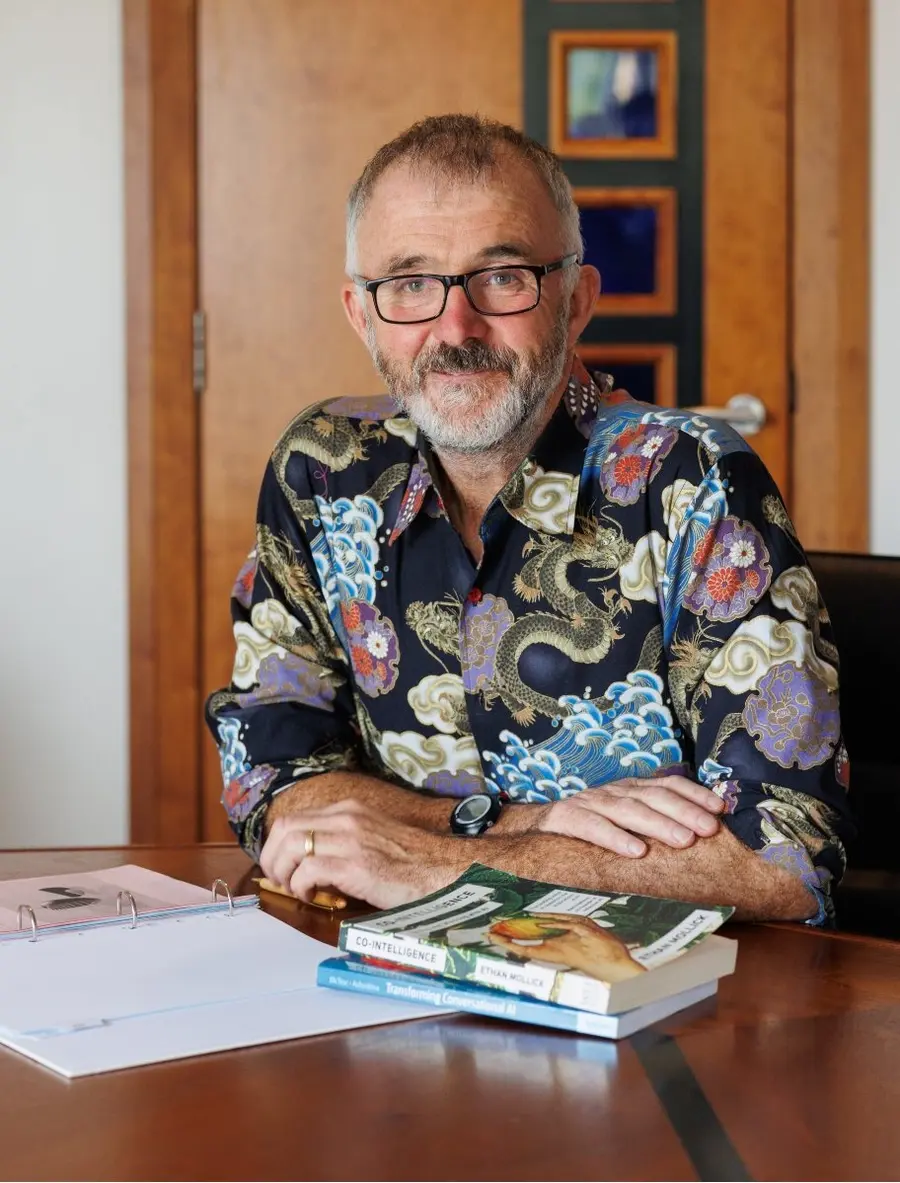

Barry Phillips (CEO) BEM founded Legal Island in 1998. He is a qualified barrister, trainer, coach, and meditator, and a regular speaker here in the UK and Ireland, and abroad.
Barry has completed the Oxford University course “Leading AI Implementation” in June 2026. He has trained hundreds of HR Professionals on how to use GenAI in the workplace and is the author of the book “ChatGPT in HR – A Practical Guide for Employers and HR Professionals”




This week Barry Phillips looks at the key takeaway for HR from the new AI book everyone is taking about.
Transcript:
Hello Humans!
My name is Barry Phillips. And welcome to the weekly podcast that aims to address a key development in AI relevant to HR in around five minutes.
Last month, another book on AI hit the shelves. So, what, I hear you cry? Who needs yet another book on AI? Well, stay with me, because this one is different.
It’s called Co-Existence: The Next Phase of AI, and it’s written by Ethan Mollick, Associate Professor of Management at the Wharton School, University of Pennsylvania. When Mollick writes about AI, people of influence tend to listen. His previous book, Co-Intelligence, was a New York Times bestseller and a Best Book of the Year for both The Economist and the Financial Times. Co-Existence looks set to be even bigger. When I finished the book last week the next thing I did was start to read it all over again. It’s that good.
The new book is about working alongside AI that is sometimes, but not always, better than we are. And Mollick starts with the sheer pace of change.
Here’s a striking example. Back in 2022, expert forecasters were asked how likely it was that AI would win a gold medal at the International Mathematical Olympiad by 2025, the toughest maths competition for young people in the world. Their answer? Less than a one-in-ten chance. Then, in July 2025, AI systems from both Google DeepMind and OpenAI achieved gold-medal-level scores. The experts didn’t just get the timing wrong; they were confidently wrong.
Mollick also enjoys debunking a few myths. Take water. You’ll often hear that AI is draining the planet dry. Mollick puts it in context. According to the US Geological Survey, America uses around 281 billion gallons of fresh water every single day. Against that, data centres are a small slice. In fact, by many estimates, US golf courses still use more water than all of the country’s data centres put together. That doesn’t mean there are no local pressures, but it does mean the headline fear is often out of proportion.
But for all the insights and fresh perspectives, what’s the big takeaway for HR? I think it’s this.
Mollick argues that the biggest gift leadership can give HR is clarity. Clarity about what the organisation actually expects from AI, and why it’s being introduced in the first place.
Think about it from an employee’s point of view. If you’ve just discovered that AI can do in twenty minutes what used to take you a day, do you shout about it? Not if you suspect your reward will be a redundancy letter. You’ll keep it quiet. You become what Mollick has called a “secret cyborg”, quietly using AI and telling no one.
Now flip it. If HR can say, with the full backing of leadership, that AI is about growth, not redundancies, everything changes. People feel safe to share their discoveries. One person’s shortcut becomes a team’s new process. A team’s new process becomes an organisation-wide advantage. Results get shared, ideas multiply, and the learning compounds.
That, says Mollick, has competitive advantage written all over it.
So, what’s the key takeaway: before you roll out another AI tool or training programme, go and get an honest answer from the top. Why are we doing this? Growth or cuts? Your people are already asking that question. Make sure HR has the answer first.
So, here’s my closing thought. The organisations that win with AI won’t be the ones with the biggest tech budgets. They’ll be the ones where people aren’t afraid. Fear makes people hide what they’ve learned. Trust makes them share it. And HR sits right at the point where fear turns into trust or doesn’t. That’s not a side role in the AI story. That’s the lead role. So go and claim it.
Thanks for listening as always. Until next week bye for now.


 Get the Most from Copilot (Level 2): A Practical Guide for HR